

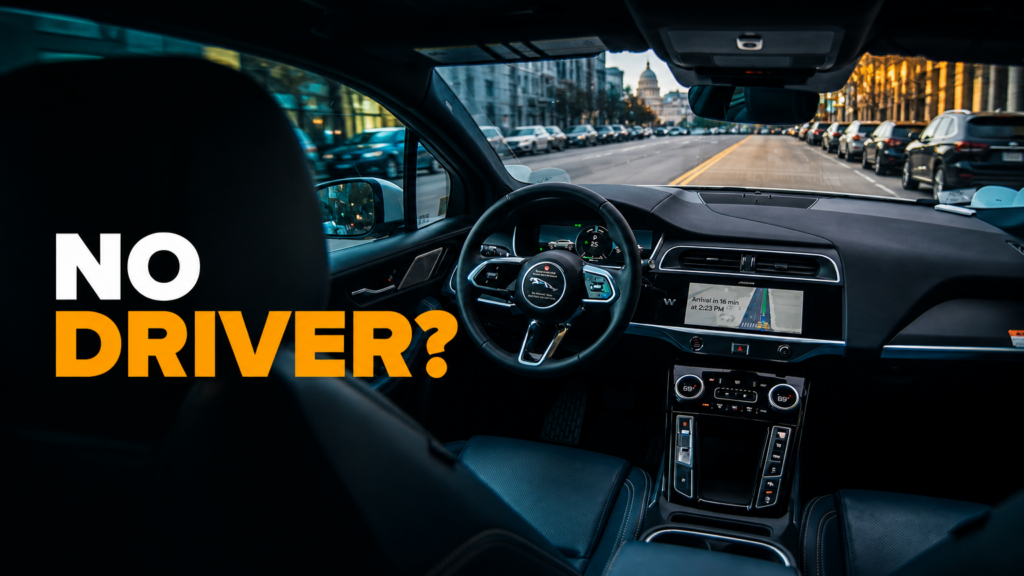
At 2:36 p.m. on Thursday, August 27, an unoccupied Waymo came to a stop in a travel lane on West 8th Avenue near Delaware Street, a block from Denver Health. There was no intersection, no stop sign, no crosswalk. Mark Kibler stopped his van behind it. Seconds later, Alfredo Arrieta’s car hit the van, shoving it into the robotaxi. Airbags deployed. Both drivers walked away with minor injuries, and both were left with the same question Arrieta asked on camera: “Like, how do I explain this to my insurance?” (CBS News Colorado).
Waymo says the vehicle slowed steadily and stopped to yield to a pedestrian waiting at the curb, who then crossed without incident. Kibler says he never saw anyone. Denver police cited Arrieta for following too closely and recorded the contact with the Waymo as a secondary collision. It is the only Waymo crash Denver police have on record (CBS News Colorado). It will not be the last.
On September 1, 2026, Waymo opened its fully driverless service to the Denver public: dozens of its new Ojai vehicles serving a roughly 60-square-mile zone that includes downtown, LoDo, Capitol Hill, Cherry Creek, Coors Field, Ball Arena, and Empower Field, rolling out first to the tens of thousands of residents already on the app’s waitlist (The Colorado Sun, The Denver Post). Denver is Waymo’s 14th city and its first true winter market (Denver Gazette).
If one of these vehicles injures you, hits your car, or you are hurt riding inside one, the ordinary accident playbook only gets you halfway. Colorado wrote its autonomous-vehicle statute in 2017, years before this technology was viable (Denverite), and the state’s regulators admitted this August that their rules still assume a human driver is present. This guide covers the parts that differ: who the law treats as the driver, who actually pays, the evidence only Waymo can produce, and the filing deadlines that can quietly kill a claim.
The first hour: what to do at a crash with no driver
Most of your instincts still apply: check for injuries, call 911, get a police report, take photos. What changes is the exchange of information, because there is nobody in the other seat. Waymo publishes its own collision instructions, and they contain details most drivers will never think to look up until they need them (Waymo Help: What to do after a collision).
Anyone hurt? Call 911 first.
The Waymo detects collisions on its own and alerts its support team, but that call is about the car. Your call is about the people. Under Colorado law, a crash involving injury must be reported to police immediately (C.R.S. 42-4-1606).
Watch where the Waymo goes.
After a collision the vehicle may keep driving to reach a safe stopping spot. A lit dome light signals that the Waymo Driver knows an event occurred. Note the direction it goes and its plate number.
Document the scene before anything moves.
Photos of damage, the vehicle’s sensor array, skid marks, debris, and exactly where each vehicle ended up relative to the nearest cross street. The August 27 crash turned on whether anyone was standing near the curb. Scene geometry is the dispute.
Collect witnesses while they are still there.
In a normal crash the other driver gives a statement. Here the only neutral accounts belong to bystanders, so names and phone numbers matter more than usual.
Exchange information with Waymo itself.
Four official channels: call 1-844-263-9885, fill out Waymo’s online collision form, scan the QR code on either front door, or email insurance@waymo.com. A roadside-assistance rep may come to the scene, but you are not required to wait for one.
Get the police report number, then see a doctor the same day.
Adrenaline masks soft-tissue injuries, and a same-day medical record ties those injuries to the crash instead of to “something you did later.”
Do not give a recorded statement or sign anything.
Waymo’s risk and insurance team reviews every collision and will follow up. Politely decline recorded interviews and early settlement paperwork until you know what your injuries are worth.
Who is the “driver”? Colorado answered in 2017, sort of
Colorado is one of the states that already has an autonomous-vehicle law on the books. C.R.S. 42-4-242, passed as Senate Bill 17-213 and effective since August 2017, permits an automated driving system to operate a vehicle if the system can comply with applicable state and federal law, and it contains the sentence that governs every future Denver robotaxi claim:
Translation: Colorado did not invent a special rule for robot crashes. The same negligence law that applies to a distracted human driver applies to the software. In practical terms, your claim runs against Waymo, the company that owns, operates, and remotely supervises the fleet, and in some cases against vehicle or software suppliers under product-liability theories.
The statute has a second clause that matters at the scene. Subsection (2) says provisions of the traffic code that “by its nature” regulate a human driver do not apply to the automated system, except laws about physically driving the vehicle. The duties to stop, remain at the scene, and hand over an insurance card are written for people. For a Waymo, the QR codes, the 844 number, and the email address stand in. If the car leaves the scene to reach a safe spot, the practical remedy is the plate number and Waymo’s own logs, not a fleeing-driver pursuit. (That reading is our analysis of how the statute and Waymo’s published process fit together. No Colorado court has ruled on it yet, and no court anywhere has had to do this very often.)
| Dimension | An ordinary Denver crash | A crash with a driverless Waymo |
|---|---|---|
| Who you talk to | The other driver, at the scene. | Nobody in the car. Waymo’s support and risk teams by phone, QR code, or email. |
| Insurance info | Handed over on a card or by police. | QR code on the front door, or downloaded from Waymo. The policy’s limits for Colorado have not been made public. |
| Who decides fault | Police citation, adjusters, eventually a jury applying negligence law. | Same law, but the decisive witness is sensor data Waymo recorded and controls. |
| Key evidence | Photos, witness statements, the drivers’ own accounts. | Lidar, 13 cameras, radar, and the software’s decision logs, all inside the vehicle. |
| Who you sue | The other driver. Their insurer defends and pays. | Waymo (and possibly Alphabet or parts suppliers), on negligence or product-liability theories. |
| Deadline to sue | Three years for injury from a car crash. | Three years for negligence. A strict product-liability claim may fall under Colorado’s two-year limit instead. |
Who actually pays? It depends on where you were standing
Waymo operates in Denver under a passenger-carrier permit from the Colorado Public Utilities Commission, effective June 12, 2026. It applied under a luxury-limo-style credential rather than as a transportation network company like Uber or Lyft, and on August 12 the PUC granted it a two-year waiver from eight rules that assume a human driver, including driver qualification files, medical-fitness documentation, and hours-of-service limits. As a passenger carrier, Waymo must report its crashes to state regulators (Denverite, The Badger).
What does that mean for the money? Here is the honest state of play, role by role.
| If you were… | The likely source of compensation | What is confirmed vs. unknown |
|---|---|---|
| A driver or passenger in another vehicle hit by a Waymo | Waymo’s commercial auto liability policy, filed with its PUC permit. If another human driver shares the blame, their policy too. | Confirmed: Waymo carries commercial coverage and its risk team handles claims (insurance@waymo.com). Unknown: the dollar limits in Colorado. When The Colorado Sun asked what happens if a Waymo crashes here, Waymo did not provide details. In California, where its largest fleet runs, deployment rules are built around $5 million in financial responsibility. |
| A pedestrian or cyclist struck by a Waymo | Same commercial liability policy. Colorado’s comparative-fault rules apply, so jaywalking or riding outside a bike lane can reduce your recovery. | Confirmed: ordinary negligence law governs (C.R.S. 42-4-242(5)). Waymo’s own data shows its vehicles in 13 other cities have hit pedestrians, including a 9-year-old in Santa Monica now under NTSB investigation. |
| A paying rider inside the Waymo | Waymo provides riders limited medical coverage regardless of fault, plus a no-deductible auto medical-payments benefit for expenses from services rendered within three years of the crash. You can also claim against a negligent third-party driver. | Confirmed: the rider MedPay terms are published by Waymo. “Limited” is Waymo’s word, and it is not a substitute for a full injury claim when injuries are serious. |
| Hurt by another driver who hit a Waymo (like the August 27 chain reaction) | The human driver’s liability policy. If that driver is uninsured, your own uninsured-motorist coverage, a live issue in Colorado, where roughly 18% of drivers carry no insurance. | Confirmed: Denver police faulted the rearmost human driver in the first crash. Note the twist: if evidence later shows the Waymo stopped negligently, Waymo may share fault. |
| The driver who hit a Waymo | Your own liability insurer pays Waymo’s property damage. Robotaxi repair bills can run high because of the sensor suite. | Confirmed: the other driver’s insurer pursued claims in other cities after rear-ending Waymos, which make up a large share of the serious crashes in Waymo’s data. |
The evidence problem: the best witness works for Waymo
Every Ojai on a Denver street is a rolling evidence locker: lidar, radar, and 13 cameras watching 360 degrees around the car, with the software’s perception and decision logs recording what it “saw” and why it acted. In the August 27 crash, the entire case is whether a pedestrian was waiting at that curb, and only one party has footage from inside the vehicle.
Waymo says it cooperates with police, and it did at that scene. But cooperation is not the same as early, complete disclosure to an injury claimant, and onboard data is overwritten on cycles that are not public. Courts treat a party’s failure to preserve relevant evidence as spoliation, but the protection is only real if someone demands preservation before the data is gone. An attorney’s spoliation letter, sent within days, asks Waymo to retain the sensor data, camera footage, and event logs for the specific vehicle, time, and location. It is the single step most likely to change the outcome of a disputed robotaxi case, and it has no equivalent in a normal two-car crash.
Waymo controls it
Lidar and radar point clouds of the scene All 13 camera feeds, inside and out The software’s perception and decision logs Vehicle speed, braking, and positioning history Remote-assistance interactions during the event Fleet-wide data on similar near-stopsYou can capture it
Your photos and video, taken at the scene Witness names and phone numbers Nearby doorbell and business security cameras (ask within days; footage is recycled) Your medical records from the same-day visit The ride receipt or the time and plate if you were outside the carThe government holds it
Denver Police crash report and any citation Crash reports Waymo must file with the Colorado PUC as a passenger carrier NHTSA crash reports, required within a day for serious AV crashes under a 2021 standing order NTSB investigation files, if the crash draws oneThe clocks: three years, two years, and a 50% cliff
Colorado’s deadlines do not change because a robot was involved, but the mix of claims in a robotaxi case can put two different clocks on the same injury. The three-year statute of limitations in C.R.S. 13-80-101(1)(n) covers all tort claims for bodily injury or property damage arising out of the use or operation of a motor vehicle, and the statute itself carves strict-liability and failure-to-warn claims out of that three-year window and into the two-year limit of C.R.S. 13-80-102. A claim that a Waymo driver negligently hit you gets three years. A claim that the software was defectively designed may get two. Wrongful-death claims carry a two-year limit under C.R.S. 13-21-203. The safe course is to treat the shortest plausible deadline as the one that governs your case.
The second rule is Colorado’s modified comparative fault statute, C.R.S. 13-21-111. Your recovery shrinks in proportion to your share of fault, and if your fault equals or exceeds the other side’s, you recover nothing. Robotaxi defendants have a built-in incentive to use this: the August 27 pattern, a human rear-ending a stopped Waymo, is exactly the fact pattern where fault gets pushed onto the person rather than the machine.
| Claim type | Colorado deadline | Statute |
|---|---|---|
| Negligence, injury or property damage from a motor vehicle | 3 years from the crash | C.R.S. 13-80-101(1)(n) |
| Strict liability / product-defect theory | 2 years | C.R.S. 13-80-102 |
| Wrongful death | 2 years | C.R.S. 13-21-203 |
| Waymo rider MedPay expenses | Services rendered within 3 years of the crash | Waymo’s published policy terms |
Riding inside or hit from outside: two different claim paths
You were a rider in the Waymo
You were outside: driver, cyclist, pedestrian
What 13 other cities predict for Denver
Waymo has been running driverless rides since October 2020, and the record from its other markets tells you both what the vehicles do well and where they stumble. Since 2021 the company has self-reported roughly 1,700 crashes to federal regulators; 157 involved at least one injury and two ended in a fatality, and in neither fatal crash was Waymo found at fault (Denverite). An Ars Technica analysis found most serious crashes happened when a human-driven car rear-ended a Waymo, while three Waymo-caused crashes followed the car stopping because its sensors were obstructed. That is precisely the shape of Denver’s first crash: a mid-block stop, a chain reaction, and humans cited for what followed.
Waymo’s own numbers are strong, with caveats attached. Read both columns before you trust either.
Waymo’s safety case
- 220 million+ fully autonomous miles through March 2026, over 4 million per week.
- 94% fewer crashes causing serious or fatal injury than human drivers in the same areas, 82% fewer crashes with any reported injury.
- 93% fewer injury-causing crashes involving pedestrians, 84% fewer involving cyclists and motorcyclists.
- An estimated one fewer serious-injury crash every eight days at current scale. (All figures from Waymo’s June 24, 2026 safety update.)
The independent caveats
- Waymo computed its own human benchmark. Advocates for Highway and Auto Safety notes the fleet’s miles are about 0.004% of what Americans drive in a year (The Verge).
- NHTSA is investigating repeated failures to stop for school buses: 20 incidents cited by Austin’s school district in one school year, the 20th citation arriving after Waymo said it had shipped a fix (CBS News).
- The NTSB is investigating a Waymo that struck a 9-year-old crossing near a Santa Monica school.
- Incidents like blocking an ambulance or stranding in traffic rarely enter the reported statistics at all.
Two Denver-specific stress tests sit ahead. The first is winter: Denver is Waymo’s first city with regular snow, and the company has only tested winter driving in the Sierra Nevada, Michigan, and New York, with defined thresholds for when its cars will operate in bad weather (Denver Gazette). The r/Denver thread on the launch’s service map had one comment that kept coming back in different forms: “Will be interesting to see how they do with snow and ice” (r/Denver). Snow hides lane markings, blocks cameras, and changes how every other driver behaves, so the first real storm is the fleet’s first real test, and probably its first cluster of disputed crashes. The second is volume: Waymo already provides about 500,000 rides a week across its cities and plans 20 more (Denverite, Colorado Sun). More miles means the question this article answers stops being hypothetical for someone new every week.
When to bring in a lawyer
You do not need an attorney to get your car fixed, and Waymo’s process is designed so a minor property claim can run without one. The calculus changes when anyone is hurt, when fault is disputed (the most likely scenario in a mid-block stop like the August 27 crash), or when the other side controls the decisive evidence. The early steps that decide these cases, the preservation demand, the same-day medical record, declining the recorded statement, happen in the first week, not the first year.
If you are weighing representation, know the economics first: Colorado injury firms work on contingency, so the fee is a percentage of what is recovered and the consultation costs nothing. Our earlier guide explains what a car accident attorney charges in Colorado and what that percentage typically buys. The Advocates handles car, truck, pedestrian, and rideshare injury claims statewide, and a robotaxi case starts the same way every case does: with a free review of what happened and what your claim is worth.
- CBS News Colorado: Denver drivers question Waymo behavior after chain-reaction crash (Aug. 27, 2026)
- The Colorado Sun: Waymo will offer public rides in Denver starting Tuesday (Sept. 1, 2026)
- The Denver Post: Waymo’s Denver fleet is set to start providing driverless rides to the public today (Sept. 1, 2026)
- The Colorado Sun: Waymo cars will land in Denver “soon.” Here’s what you should know (Aug. 21, 2026)
- Denver Gazette: Waymo to launch in its first “true” winter city soon (Aug. 20, 2026)
- Denverite: Taxi companies want to block Waymo’s plans in Denver (July 9, 2026)
- The Badger: Colorado PUC keeps Waymo rule relief temporary (Aug. 14, 2026)
- Denverite: Denver is becoming a Waymo city. Here’s how that has worked out across the country (July 28, 2026)
- Waymo Help: What to do after a collision
- Waymo: Additional protection on Waymo rides (rider medical-payments coverage)
- Waymo: From the road safety update (June 24, 2026)
- The Verge: Waymo hits 170 million miles while avoiding serious mayhem (March 19, 2026)
- CBS News: U.S. expands investigation into Waymo over robotaxis driving around stopped school buses (Dec. 5, 2025)
- C.R.S. 42-4-242, Automated driving systems and C.R.S. 42-4-1606, Duty to report accidents
- C.R.S. 13-80-101, Limitation of actions and C.R.S. 13-21-111, Negligence cases
- Colorado PUC: Transportation Network Companies
- r/Denver: Current Waymo Service Area (Sept. 1, 2026)