

Denver recorded 16,540 distinct traffic accident incidents in its public dataset for 2025, an average of about 45 per day. Separately, the city reports 94 traffic deaths that year. Together, these figures describe two different concerns: how often crashes are recorded and their human consequences.
For drivers, passengers, and families, useful Denver car accident statistics need more than a headline number. The reporting period, geographic boundary, and definition of each measure matter. So does knowing what to do when a collision becomes personal.
Data checked September 10, 2026. Annual comparisons below cover complete calendar years within the City and County of Denver.
How many car accidents happen in Denver?
An analysis of the city’s Traffic Accidents (Offenses) dataset, counting each incident identifier once and filtering by first occurrence date, produces the following annual totals:
| Year | Distinct recorded crash incidents |
|---|---|
| 2021 | 18,475 |
| 2022 | 18,073 |
| 2023 | 18,369 |
| 2024 | 17,573 |
| 2025 | 16,540 |
The 2025 total was 1,033 incidents lower than 2024, a 5.9% decrease. Dividing 16,540 by 365 gives 45.3 recorded incidents per day. That is an annual average, not a prediction of tomorrow’s collisions or a claim that crashes happen at evenly spaced intervals.
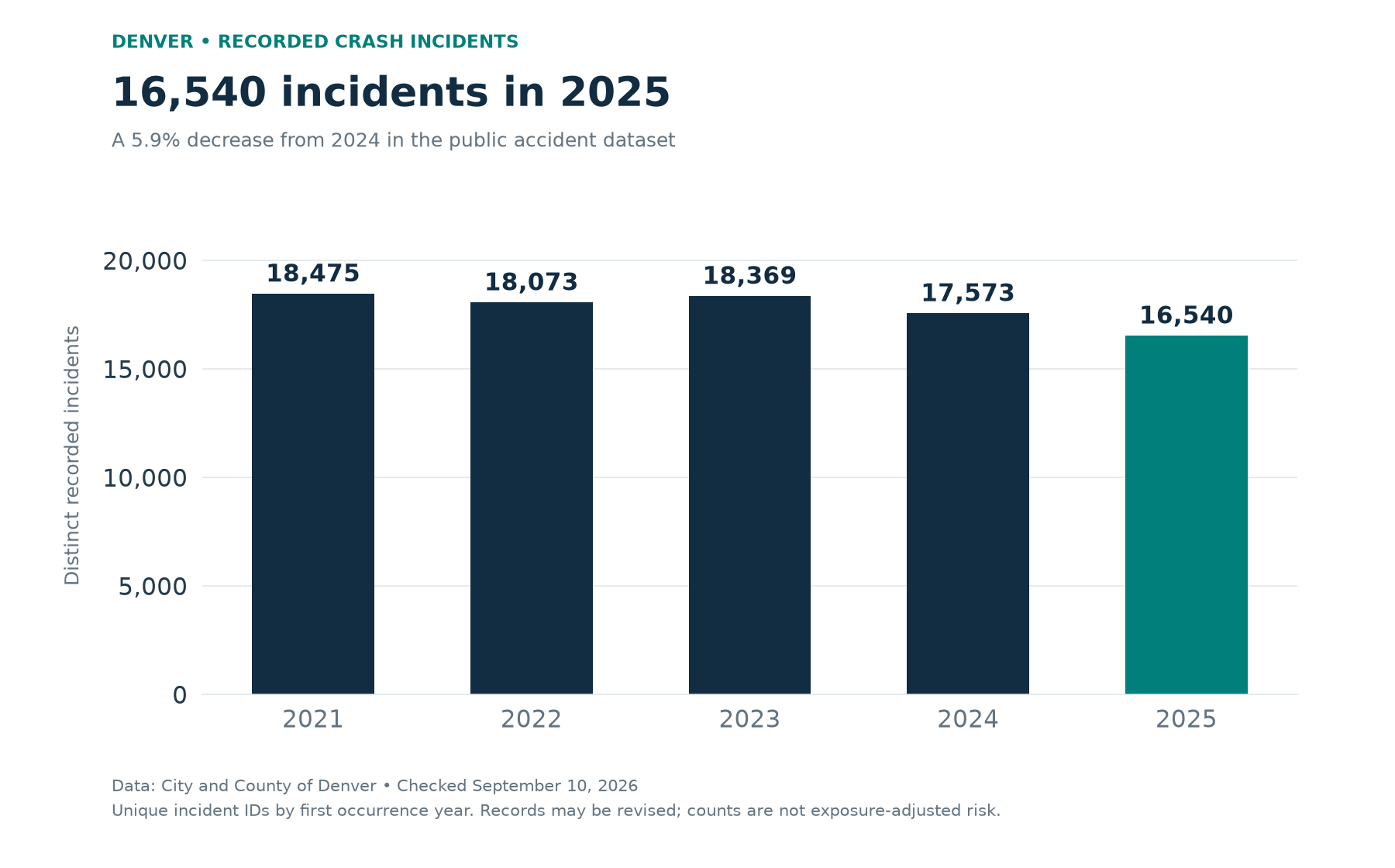
These are recorded traffic incidents, not a passenger-car-only total. They describe events within Denver’s city and county boundaries, not the entire metropolitan area. They also cannot capture a collision that never enters the database.
The city describes the dataset as dynamic, with records updated Monday through Friday. Additions, deletions, and corrections can change historical totals. Keeping the extraction date beside the numbers makes later comparisons more useful.
Counting incidents also avoids a subtle spreadsheet mistake. An offense table can contain multiple entries associated with the same incident. For example, the 2024 extraction contains 17,574 rows but 17,573 distinct incident identifiers. The annual table uses the distinct count consistently. Simply counting spreadsheet rows would answer a slightly different question.
Traffic deaths measure a different kind of harm
Denver’s Vision Zero statistics page reports 94 traffic deaths in 2025. That counts people killed, rather than collisions, vehicles, or insurance claims. It is a citywide traffic fatality figure, not a count limited to people inside cars.
A fatal crash and a fatality are different units: one collision can kill more than one person. Likewise, a crash involving an injury is not the same measure as the number of injured people. Keep those labels intact when comparing charts or discussing an accident with an insurer.
Use the dedicated Vision Zero death figure for this measure. The public accident file’s fatality fields do not reconcile with that total, so combining the two systems into a fatality percentage would be misleading. The city also warns that some dashboard connections may not be current.
A full year of deaths should be compared with another full year using a consistent reporting method. A running 2026 count cannot establish improvement against all of 2025. The same caution applies to ranking Denver against another city without accounting for population, traffic exposure, and reporting differences.
More than one-third were classified as hit-and-run
Within the same 2025 accident dataset, 6,162 incidents had hit-and-run as their top traffic accident offense, representing 37.3% of the 16,540 incidents. The remaining 10,378 carried other top offense classifications.
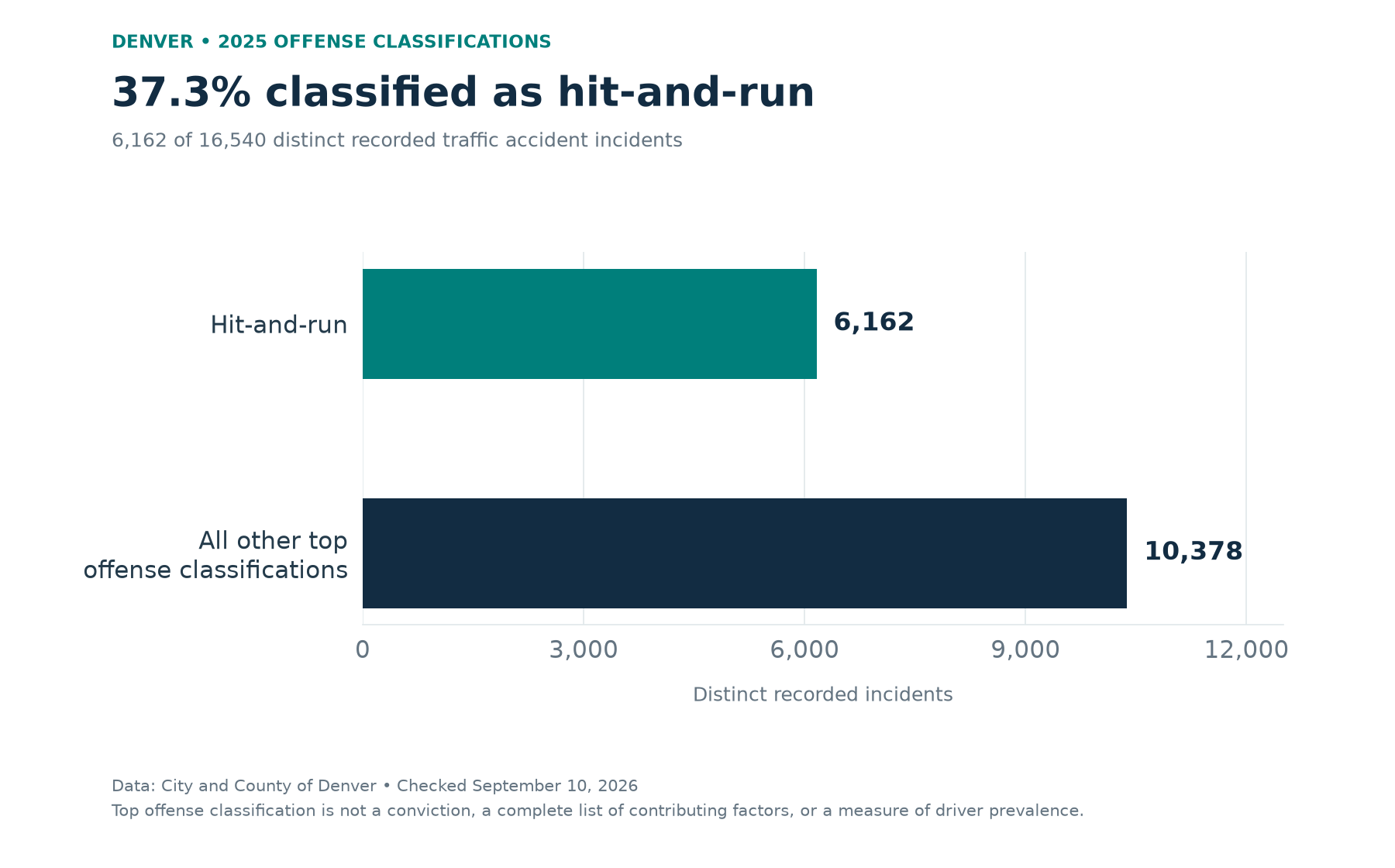
The distinction matters. A top offense label does not describe every contributing factor, prove fault in an individual case, or establish how many drivers were ultimately convicted. It should not be turned into a claim that 37.3% of all Denver drivers flee crashes.
For consumers, the practical preparation is straightforward: keep your insurance information accessible and know how to record identifying details safely. After a suspected hit-and-run, note the vehicle’s plate, color, make, and direction of travel if possible. Preserve dashcam footage and witness contact information. Avoid chasing another vehicle; give available details to the responding authorities. A crash involving a vehicle without a human driver creates additional documentation questions, so review what to do after a Waymo crash in Denver.
Dry roads still account for most recorded crashes
Denver’s 2025 records list 15,183 incidents on dry road surfaces, including the dry-with-visible-treatment category. That is 91.8% of all recorded incidents. Wet surfaces account for 713; ice, snow, or slush for 289; other known conditions for 26; and blank or under-investigation entries for 329.
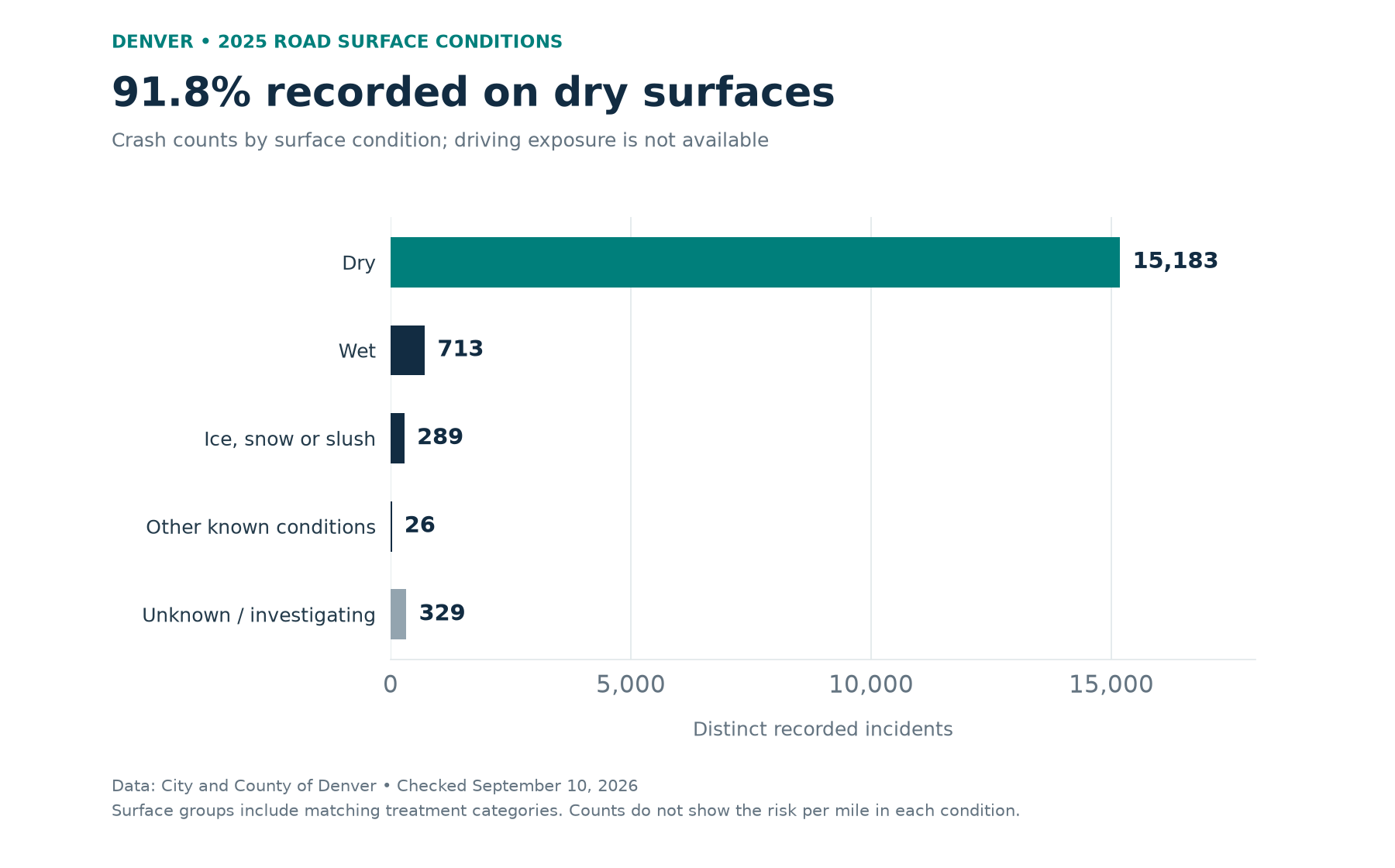
This does not mean dry pavement is more dangerous per mile than snow. The totals do not tell us how much driving occurred in each condition. Road surface also is not a complete weather description or a finding about what caused a collision.
The useful takeaway is to make safety habits routine in ordinary conditions. Put the phone away, leave room to stop, and check for people walking or cycling before turning. Treat clear pavement as one piece of the driving situation, alongside visibility, traffic, and the movements of others.
Use the numbers to ask better safety questions
When evaluating a commute, school pickup route, or neighborhood intersection, start with the question you actually need answered. A high crash count identifies a place worth examining; by itself, it does not show your personal probability of being injured there.
Ask whether a comparison uses the same years, geographic boundaries, and severity definitions. Check whether counts describe all crashes, injury crashes, or people harmed. For a specific intersection, consider requesting information about turning movements, crossings, and traffic volume before declaring one route safer than another.
For your own travel, choose a route you can navigate calmly and allow enough time to avoid rushing. Use crash statistics to identify questions and prepare, rather than treating a citywide average as a forecast for your next trip.
Make a route review specific: identify the turns you find difficult, places where parked vehicles obstruct your view, and crossings used by your household. Write down the location and concern before contacting the city. A description such as “visibility is blocked on the approach to this crossing” gives a clearer starting point than a claim that the whole neighborhood is dangerous.
After a Denver car accident, build a clear record
After a Denver car accident, call 911 if anyone is injured or there is an immediate danger. Put personal safety ahead of photographing damage. Once you can document events safely, keep a simple record organized around three questions: what happened, who can verify it, and what did it cost?
Save scene photos, witness details, the police report number, repair estimates, and relevant correspondence. Keep medical and employment records together when the long-term effects of a car accident include ongoing injuries or missed work. A dated timeline helps separate your own recollection from information learned later.
For expenses, use a short log with the date, vendor, amount, purpose, and receipt filename. Keep repair estimates separate from paid invoices, and distinguish time actually missed from work from time you expect to miss. This organization does not establish reimbursement eligibility; it makes the financial impact easier to explain without relying on memory or mixing estimates with completed payments.
When describing the collision, distinguish observation from inference. “I saw the other vehicle enter the intersection” describes an observation; guessing why its driver acted adds an assumption. If you do not remember a detail, record that uncertainty. Keep original photos and messages alongside your notes so the underlying material remains available when questions arise later.
For an injury claim, The Advocates’ Denver personal injury team describes gathering police reports, witness statements, photographs, medical documentation, and employment records. The firm’s guide to what a Denver car or truck accident attorney actually changes provides additional context before a consultation. Those services concern an individual claim; citywide crash totals do not establish fault or determine compensation.
Bring your records to any consultation and ask which facts remain unresolved, what additional evidence would help, and how fees and case expenses work. That turns a broad concern about Denver accidents into a practical next step based on your circumstances.